9 Best CustomGPT.ai Alternatives in 2026
Explore the CustomGPT AI alternatives compared on query credits, RAG grounding, citation quality, and what one customer question actually costs.
Team Nivon.AI
Sep 22, 2026
CustomGPT.ai is a retrieval-augmented generation platform. It builds AI agents grounded in your own documents, so answers come from your content rather than from the model's training data. Every answer carries source citations, which is why teams in regulated industries choose it. It supports over 1,400 document formats and connects to SharePoint, Google Drive, Zendesk, HubSpot, and Salesforce.
CustomGPT.ai bills in query credits. The Standard plan costs $99 a month and includes 1,000 queries. The Premium plan costs $499 a month and includes 5,000 queries. Both work out to roughly $0.10 per query, so moving up a tier buys volume but not a better rate.
One detail decides your real bill. A query credit is not the same as a customer question. If your agent performs a web search, that single question consumes extra credits: three additional credits on Standard and two per search on Premium. This page compares nine alternatives on what one answered question actually costs.
Quick picks
- Lowest cost per answer: Nivon, at about $0.004 per message on the $12 Starter plan.
- Best free plan: Nivon. 150 messages a month, no card, no expiry.
- Best for developer documentation: Kapa.ai, built for technical docs and developer questions.
- Best for docs with source citations at a lower cost: DocsBot, from $49/month.
- Best for helpdesk ticket deflection: eesel AI at $0.40 per ticket or My AskAI at about $0.10 per ticket.
- Best for building conversation logic: Botpress or Voiceflow, both aimed at developers.
What is a query credit in CustomGPT.ai?
A query credit is the unit CustomGPT.ai bills against. One customer question consumes at least one query credit. Actions the agent performs beyond answering consume additional credits from the same monthly allowance.
Web search is the clearest example. CustomGPT.ai's documentation states that each web search incurs two additional query credits on the Premium plan and three on the Standard plan, in addition to the original question.
The plan also caps how often this can happen. Premium allows up to three web searches per user question, adding a maximum of six credits. The standard allows one web search per question, adding three credits.
What does that mean in practice? On the Standard plan, a question that triggers a web search consumes four query credits. A 1,000-query allowance then covers 250 customer questions, not 1,000. The effective cost rises from about $0.10 per question to about $0.40.
Why teams look for CustomGPT.ai alternatives
CustomGPT.ai does several things better than most tools in this category, and those are worth stating first. Its RAG grounding is strong, answers carry citations back to the source document, and it supports more than 1,400 file types. It offers SOC 2 Type II, GDPR, and HIPAA compliance. It does not train models on customer data. For regulated industries that need traceable answers, that combination is hard to match at any price.
Here is what drives buyers to look elsewhere.
Entry price is $99 a month
CustomGPT.ai Standard costs $99 per month or $89 on an annual plan. That is the highest entry price among general-purpose RAG chatbot platforms. DocsBot starts at $49. Chatbase starts at $40. Nivon starts at $12.
Upgrade does not improve the rate
Standard costs $99 for 1,000 queries, or $0.099 per query. Premium costs $499 for 5,000 queries, at $0.0998 per query. The per-query rate is effectively identical across both plans. Most usage-based platforms reduce the unit rate as volume rises. CustomGPT.ai does not.
Plan jump costs 5x
There is no middle tier. If 1,000 queries a month is not enough, the next published plan costs $499. That is a 404% increase for five times the query allowance and the same rate per query.
Query credits are consumed by more than questions
Web search, advanced document parsing, and agent actions all draw on the same query allowance. Your published query count and your answerable question count are two different numbers.
Cost for White-labeling
Removing CustomGPT.ai branding requires the Premium plan at $499 per month. On competing platforms, branding removal is an add-on priced between $35 and $99 a month.
How to compare RAG chatbot platforms
Ask every vendor the same questions.
- What is one billable unit: a query, a message, a credit, a conversation, or a resolution?
- Do actions such as web search, document parsing, or API calls consume the same allowance?
- Does the AI model you choose change the cost per answer?
- Does the per-unit rate improve as you move up tiers, or stay flat?
- Does every answer carry a source citation, and can the user open the source?
- What happens when the agent does not know? Does it say so, or does it guess?
- What does the free plan allow, and does it expire?
- Which compliance certifications are complete rather than in progress?
CustomGPT.ai alternatives compared
| Tool | Billable unit | Entry price (monthly) | Cost per answer at entry | Source citations | Free plan |
|---|---|---|---|---|---|
| Nivon | One credit per message | $12 | About $0.004 | Yes | Yes, 150 credits, never expires |
| Chatbase | Message credits | $40 | About $0.057 per credit | Yes | Yes, 50 credits |
| DocsBot | AI credits, model-weighted | $49 | About $0.010 per credit | Yes | Yes, 100 credits |
| SiteGPT | Messages, question and reply counted separately | About $59 | About $0.015 | Yes | No, 7-day trial |
| eesel AI | Per ticket or chat session | $0.40 per ticket | $0.40 | Yes | $50 free usage |
| My AskAI | Per ticket handled | $199 | About $0.10 to $0.12 per ticket | Yes | No, 30-day trial |
| Kapa.ai | Not published | Not published | Not published | Yes | No, demo required |
| Botpress | Messages plus separate AI token spend | Free tier, then paid plans | Varies with token use | Yes | Yes, pay-as-you-go |
| Voiceflow | Credits, $0.005 each on Business monthly | Free tier, then paid plans | 1 credit per user message plus token cost | Yes | Yes, limited credits |
| CustomGPT.ai | Query credits | $99 | About $0.099, more with web search | Yes | No, 7-day trial |
The 9 best CustomGPT.ai alternatives
Nivon.AI
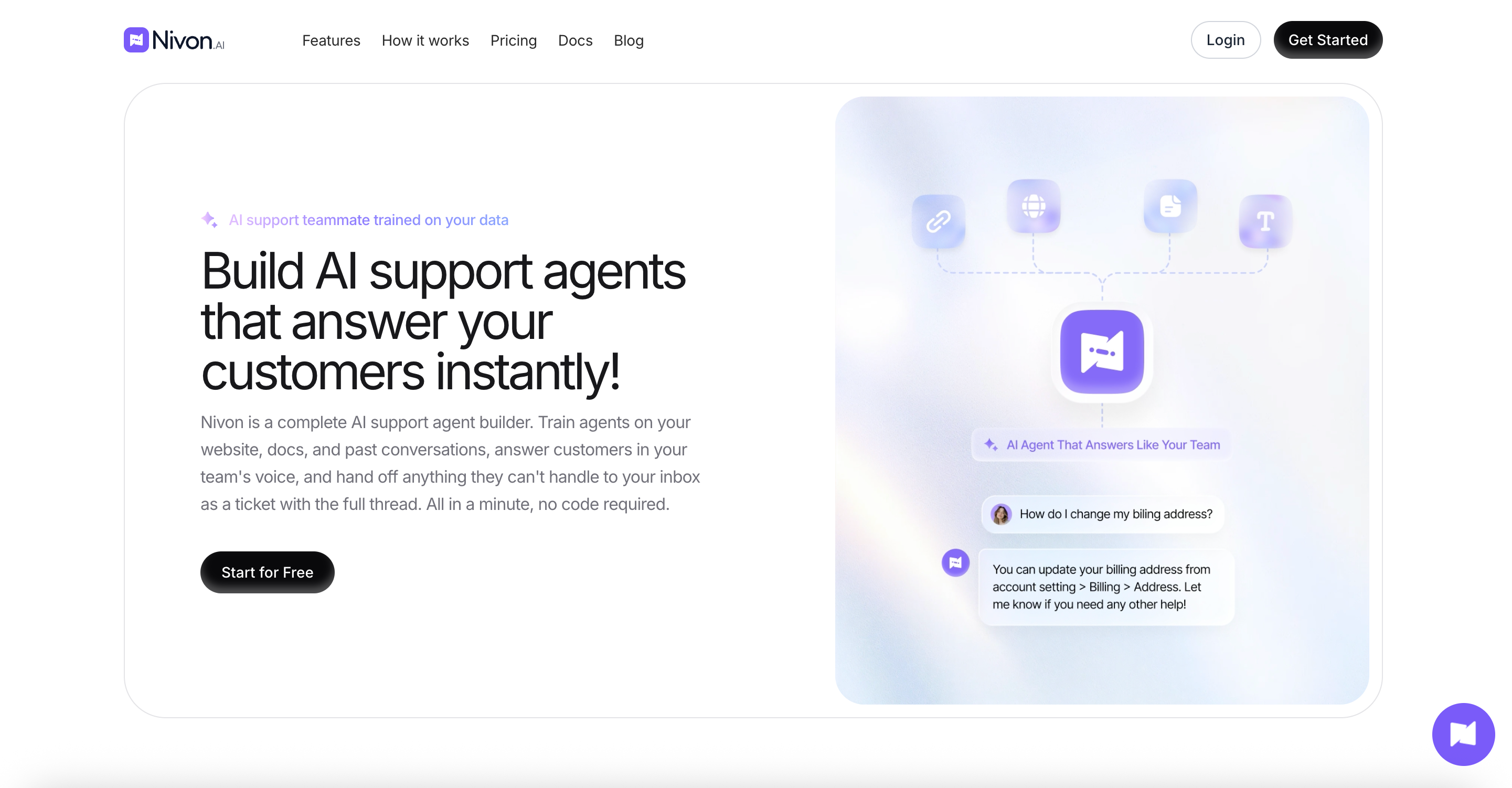
Nivon AI builds AI support agents grounded in your own content. It trains on your website, documents, FAQs, and past support tickets, then answers questions based on that material. When the agent cannot answer from its sources, it does not guess. It passes the conversation to your team with the full thread attached. Nivon was built by Pimjo, which ran it on its own products for 45 days before release.
Key features:
- Trains on website crawls, sitemaps, uploaded documents, Google Drive, OneDrive, FAQs, pasted text, and past support tickets
- 20+ models across OpenAI, Anthropic, Google, and xAI, switchable per agent
- Guardrails that define what the agent handles, refuses, never shares, and escalates
- Allowed domain rules that restrict each agent to assigned sites
- Separate workspaces with admin and member roles, keeping internal knowledge away from customer agents
- Replies in 95+ languages, matching the language the customer writes in
Pros:
- One credit equals one message. No action or model changes that rate
- About $0.004 per message on Starter, against CustomGPT.ai's $0.099 per query
- The free plan gives 150 messages a month, requires no card, and does not expire
- Seats are included up to each plan's limit, with no per-seat fee
- Content and conversations are encrypted in transit and at rest, and nothing is used to train any model
Cons:
- Supports fewer document formats than CustomGPT.ai's 1,400+
- No SharePoint connector. Google Drive and OneDrive are live, Notion is in review
- No web search, so answers come only from your connected sources
- SOC 2 Type II is in progress, not complete. GDPR, CCPA, and ISO 27001 level requirements are met
Pricing: Free at $0 with 150 credits a month and 1 team member. Starter is $12 a month, or $9 on annual billing, with 3,000 credits and 3 members. Growth is $39 a month, or $29 annually, with 12,000 credits and 5 members. Business is $79 a month, or $59 annually, with 30,000 credits and 15 members.
Best for: Teams that want grounded answers with predictable cost per message. If you need SharePoint sync or HIPAA compliance today, CustomGPT.ai covers those, and Nivon does not.
DocsBot
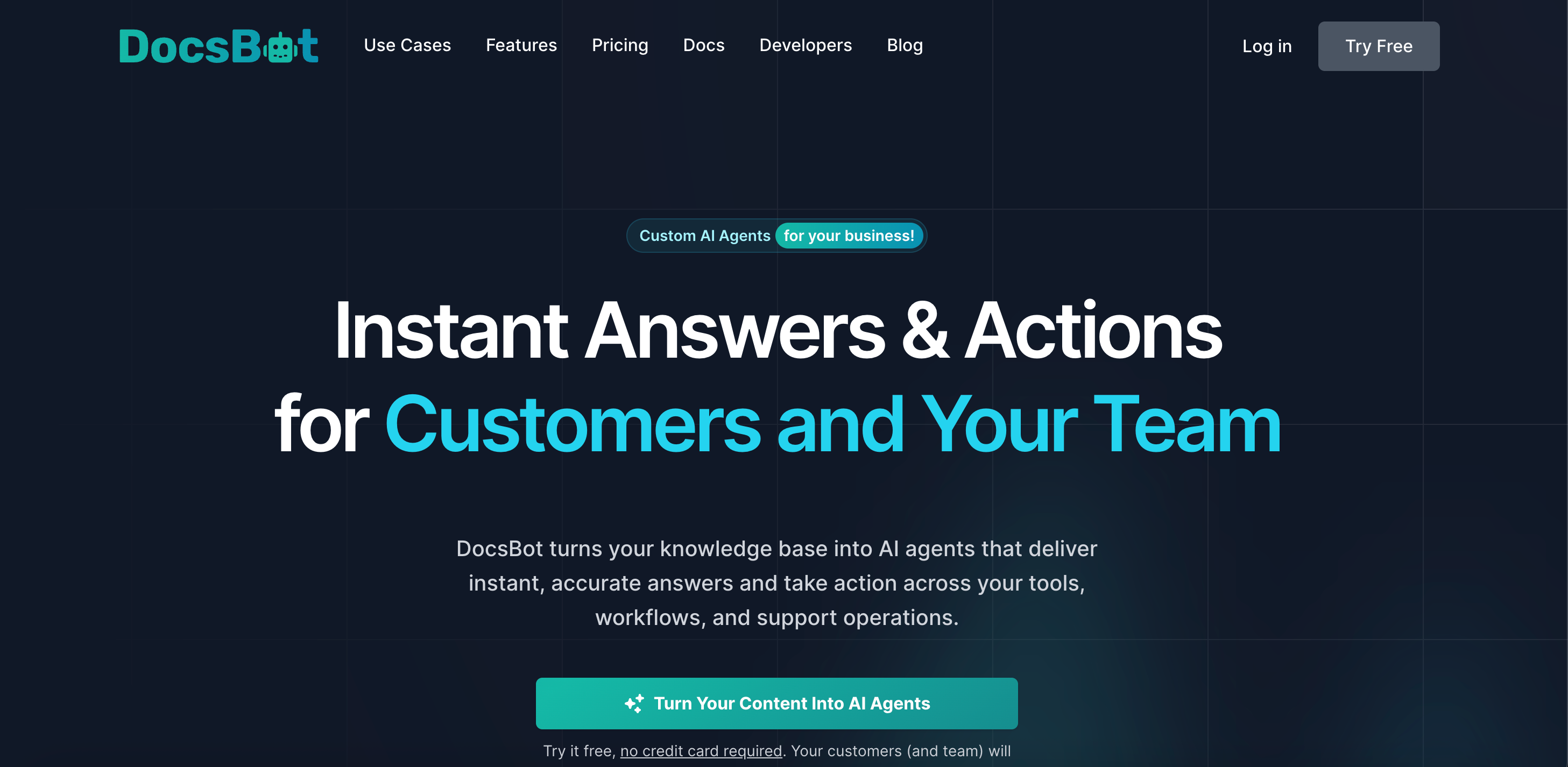
DocsBot builds chatbots trained on documentation, with source citations attached to answers. It focuses on retrieval accuracy for technical and product documentation. It connects to Slack, Messenger, WhatsApp, Telegram, and Zapier, and supports remote MCP connections. DocsBot is the closest direct substitute to CustomGPT.ai, with a lower entry price.
Key features:
- Source citations are attached to every answer
- Remote MCP connections
- Advanced document parsing for complex file layouts
- Lead collection forms and scheduling tools, including Calendly and Cal.com
- Source refresh on a monthly or weekly schedule by plan
- Actions per bot, rising by tier
Pros:
- Entry price is about half of CustomGPT.ai's
- Free plan available with 100 AI credits
- 14-day money-back guarantee
- MCP support, which few RAG platforms offer
Cons:
- Credits scale by model. DocsBot lists GPT-5.6 Sol at 20x and GPT-5.6 Terra at 8x per message
- Advanced document parsing costs 2 AI credits per page, a second draw on the same allowance
- The entry plan includes one bot and one team user
- Extra credits cost $49 per 5,000
Pricing: Free at $0 with 100 AI credits, 1 bot, 50 source pages, and 1 team user. Paid tiers add 5,000, 15,000, and 60,000 AI credits with 1, 5, and 10 team users. The AI credit add-on costs $49 per month per 5,000-credit increase. Confirm current plan prices on the pricing page.
Best for: Teams that want CustomGPT.ai's documentation grounding at a lower entry price and will pick an efficient model to control credit use.
Kapa.ai
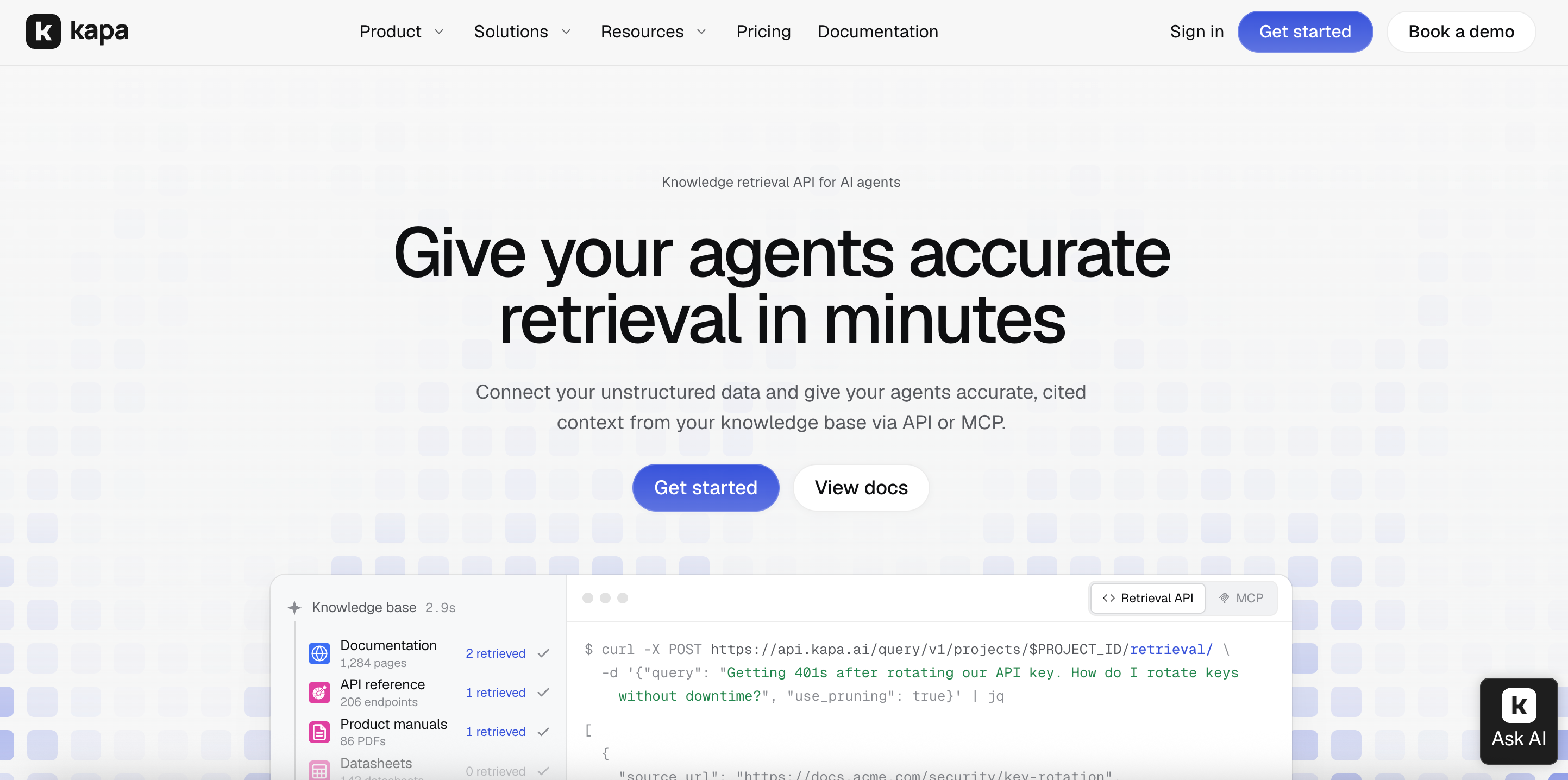
Kapa.ai builds AI assistants for technical documentation and developer questions. It indexes docs, GitHub issues, forum threads, and Slack history, then answers developer questions with citations. It is used by developer tools companies to answer API and SDK questions. Kapa.ai focuses on one job rather than general business chat.
Key features:
- Indexes documentation, GitHub issues, forums, and Slack conversations
- Source citations on answers
- Built for developer and API documentation specifically
- Analytics showing which questions the docs fail to answer
- Deploys to docs sites, Slack, Discord, and in-product widgets
Pros:
- Purpose-built for developer documentation rather than adapted to it
- Identifies documentation gaps from real questions
- Handles code, API references, and technical terminology well
Cons:
- Kapa.ai does not publish pricing. Access starts with a demo request
- No free plan and no self-serve signup
- Narrow by design, so it is a poor fit for general customer support or sales
- You cannot evaluate the cost before speaking to sales
Pricing: Not published. Kapa.ai has no public rate card and no self-serve checkout. Pricing is quoted per deployment. Any figure circulating in third-party comparisons is an estimate rather than a published rate, so request a quote directly.
Best for: Developer tools companies answering technical questions from API docs and SDK references. For general business knowledge or customer support, the other tools here cost less and do more.
Chatbase
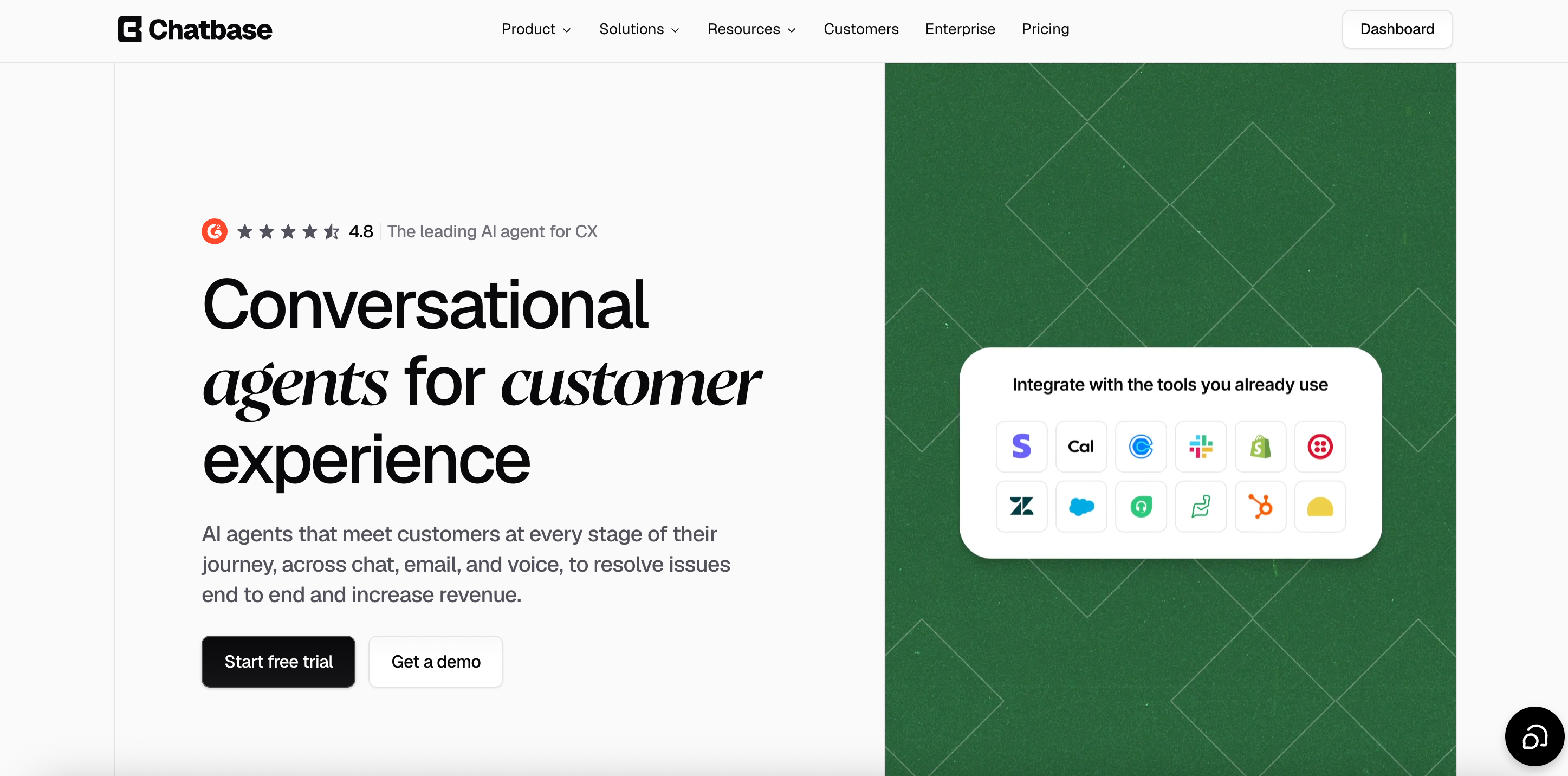
Chatbase builds AI agents trained on your documents, links, and text, then deploys them as a website widget or through messaging channels. It has the widest integration list in this category. Voice, telephony, and outbound campaigns are available from the Standard plan, which most RAG platforms do not offer at all.
Key features:
- Models from OpenAI, Anthropic, Google, DeepSeek, Meta, Mistral, and others
- AI Actions that let the agent perform tasks during a conversation
- Voice, telephony, and outbound campaigns from Standard
- Integrations with Stripe, Zendesk, Salesforce, Intercom, HubSpot, Freshdesk, Gorgias, Shopify, Slack, and WhatsApp
- Auto-retrain and source suggestions on higher tiers
Pros:
- Broader integration list than CustomGPT.ai
- Voice and telephony built in
- Free plan available for testing
- Lower entry price than CustomGPT.ai at $40
Cons:
- Every plan includes one AI agent. Extra agents cost $25 each per month
- Branding removal costs $99 a month
- Extra credits cost $40 per 1,000
- Free plan agents are deleted after 14 days of inactivity
Pricing: Free at $0 with 50 message credits and 1 member. Hobby is $40 a month with 700 credits and 2 members. The standard is $150 with 4,000 credits and 3 members. The pro is $500 with 15,000 credits and 5 members. Enterprise is custom. Yearly billing takes 20% off.
Best for: Teams that need voice, telephony, or a specific CRM connector alongside grounded answers.
eesel AI
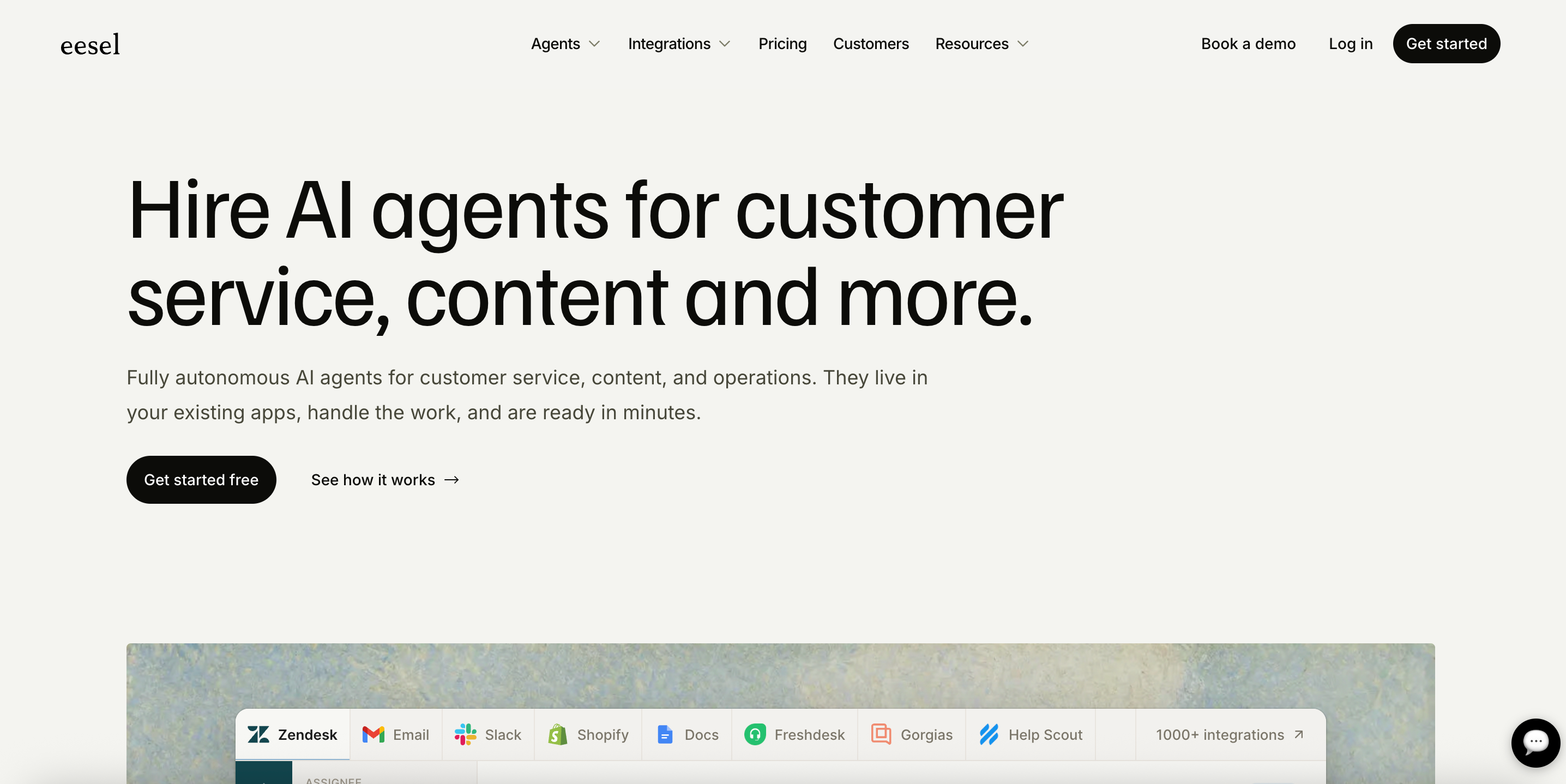
eesel AI is an AI agent that runs inside the helpdesk you already use. It trains on past tickets, help center articles, and documents in Confluence, Notion, or Google Drive, then drafts and resolves tickets inside Zendesk, Freshdesk, and Intercom. It bills per task rather than per query, and its unit definition is unusually clear.
Key features:
- Runs inside Zendesk, Freshdesk, Intercom, and similar helpdesks
- Trains on past tickets alongside documents
- Separate helpdesk, blog writer, and e-commerce agents under one account
- Simulation mode to test against historical tickets before going live
- Spending cap with alerts at 50%, 75%, and 100% of your limit
Pros:
- One ticket or chat session counts as one task, no matter how many messages it contains
- No platform fee, no per-seat fee, and no monthly minimum on the standard tier
- $50 in free usage with no credit card required
- SOC 2 Type II, GDPR, and CCPA
Cons:
- Tasks are billed regardless of outcome, so failed attempts still cost $0.40
- You continue paying for the helpdesk underneath
- Blog post drafts cost $4.00 each, ten times the ticket rate
- The Enterprise tier adds a $1,000 a month platform fee on top of usage
Pricing: $0.40 per support ticket or chat session. Light tasks, such as dashboard lookups, are free. Heavy tasks such as blog post drafts cost $4.00. There is no platform fee, per-seat fee, or monthly minimum. Enterprise costs $1,000 a month plus usage. Annual commitment saves up to 25%.
Best for: Teams already running a helpdesk who want AI to resolve tickets inside it. If you want a standalone knowledge agent for a website, CustomGPT.ai and Nivon are a better fit.
My AskAI
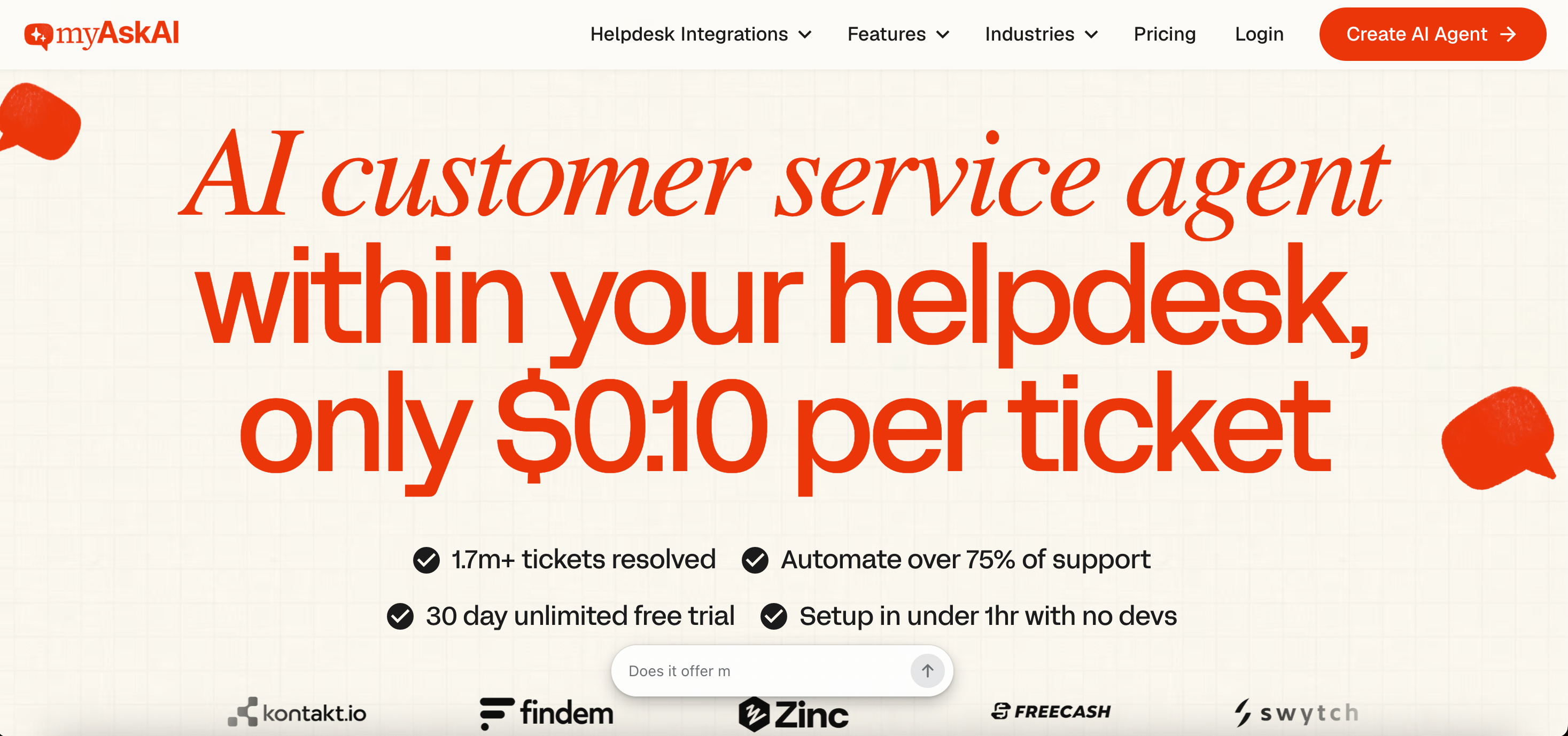
My AskAI is an AI support agent that runs inside your existing helpdesk. It integrates with Zendesk, Intercom, Freshdesk, Gorgias, and HubSpot and answers customer questions using your help content. It is built specifically for deflecting repetitive support tickets. Its unit is a ticket, not a query.
Key features:
- Runs inside your existing helpdesk with no migration
- Trains on help center articles, websites, Google Drive, and Notion
- Replies in 95+ languages
- Advanced actions, including refunds and cancellations
- AI CSAT scoring
- Historic ticket training on the Scale plan
Pros:
- About $0.10 to $0.12 per ticket, and a ticket can contain many messages
- Unlimited seats from the Scale plan
- 30-day free trial with no credit card
- SOC 2 from the Scale plan
Cons:
- The $199 monthly entry price is double CustomGPT.ai's
- Branding removal and API, Slack, and Teams access each cost $49 a month extra on Pro
- Billed for every ticket the AI handles, resolved or not
- Requires an existing helpdesk
Pricing: Pro is $199 per month with 1,000 tickets and 5 seats, plus $0.12 per ticket over the allowance. Scale is $499 a month with 2,000 tickets, unlimited seats, SOC 2, and $0.10 overage. Enterprise starts at $999 a month. Annual billing takes 33% off.
Best for: Support teams with high ticket volume on an existing helpdesk. Below about 1,000 tickets a month, the included allowance goes unused.
SiteGPT
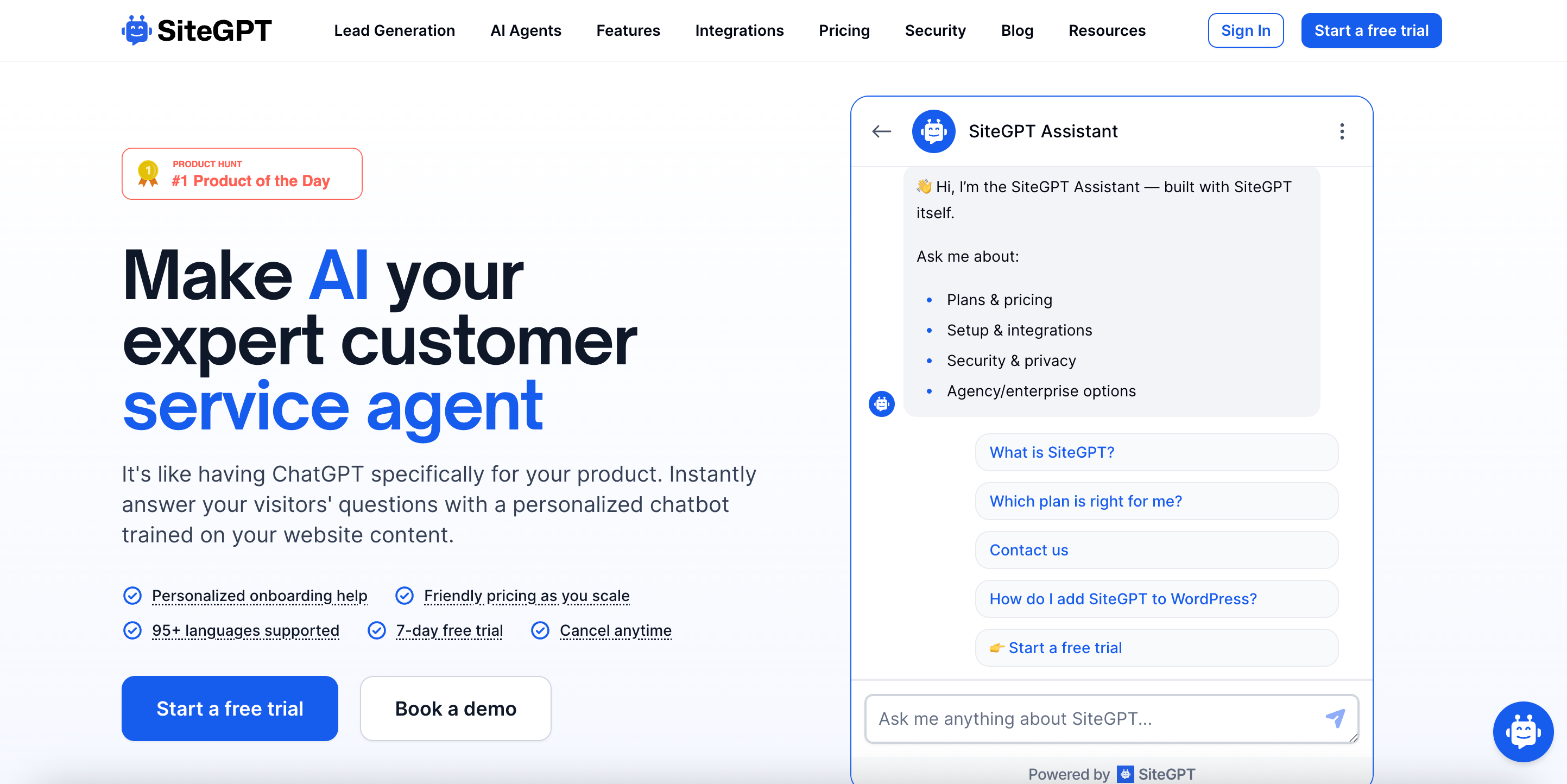
SiteGPT trains a chatbot on your website by crawling your pages. You enter a URL, select the pages to train on, and embed the result. It pulls content from websites, sitemaps, files, YouTube, GitHub, Notion, Google Drive, and Dropbox. It has the widest range of content sources among the lower-priced tools here.
Key features:
- Trains from 12 content source types, including GitHub and YouTube
- Lead capture is built into the chat flow
- Slack, Zapier, Webflow, Shopify, and WordPress integrations
- Escalation to a human agent
- White-label on higher tiers
Pros:
- Wide range of content sources
- Prominent lead capture for marketing sites
- Large annual discount against monthly billing
Cons:
- No free plan, only a 7-day trial
- The question and the reply count as separate messages, so one exchange consumes two
- Model choice changes capacity sharply, with reported allowances falling roughly tenfold from the mini model to GPT-4.1
- The price shown first is the annual rate, and the monthly rate is materially higher
Pricing: Published figures differ across sources. Reported plans run about $59, $129, and $429 per month on monthly billing, falling to about $39, $79, and $259 per month on annual billing. Confirm the current rates on SiteGPT's pricing page, and check whether the quoted figure is monthly or annual.
Best for: Teams training an agent on content spread across GitHub, Notion, and Drive who want lead capture in the widget.
Botpress
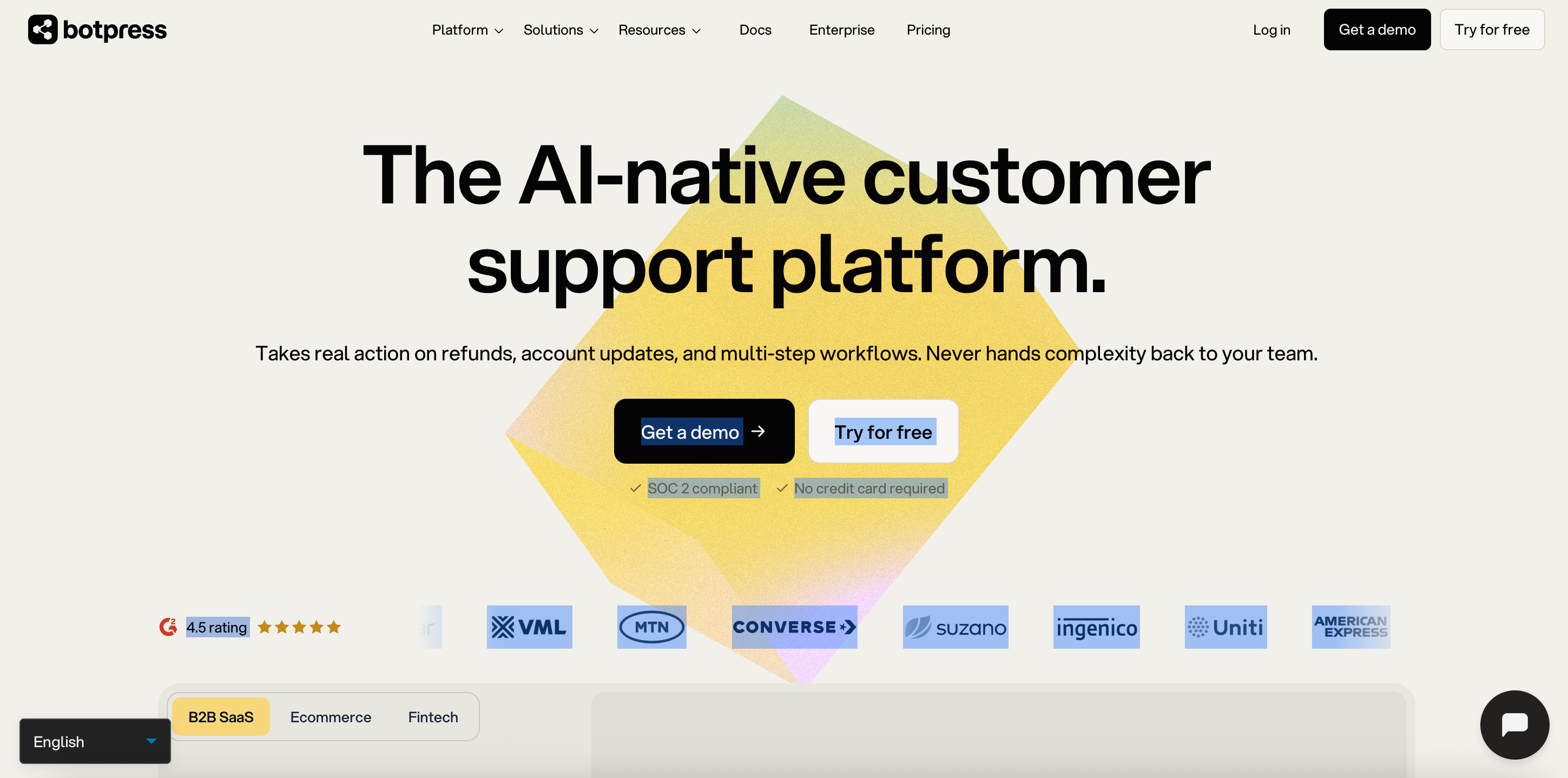
Botpress is a developer-focused platform for building conversational agents. It combines a Visual Studio with JavaScript code execution, so you can build logic that goes beyond retrieval. It includes knowledge base indexing, so agents answer from your content as well as follow the designed flows. It suits teams with engineering resources.
Key features:
- Visual Studio with drag-and-drop flow building
- JavaScript code execution inside conversations
- Knowledge base indexing with vector storage
- Human handover and conversation insights on paid plans
- Open-source foundation with self-hosting options
- Wide channel support, including WhatsApp
Pros:
- A genuine free pay-as-you-go tier rather than a time-limited trial
- Deep customization for teams with developers
- Not priced per seat
- Removing branding is included on paid plans rather than sold as an add-on
Cons:
- Subscription and AI usage are billed separately, so the plan price is not the full bill
- AI Spend is charged on token consumption, which is harder to forecast than a fixed credit
- Published plan prices differ widely across sources, so confirm directly
- Building a production agent needs developer time, not just configuration
Pricing: Botpress charges a plan fee plus a separate AI Spend based on token usage. The pay-as-you-go tier is free and includes a small monthly AI credit. Paid tiers are Plus, Team, Managed, and Enterprise. Reported prices for these tiers vary considerably between sources, so confirm the current rate card on the Botpress pricing page before budgeting.
Best for: Engineering teams that want to build custom conversation logic and can absorb token-based billing. For pure document question-answering, CustomGPT.ai and DocsBot require far less work.
Voiceflow
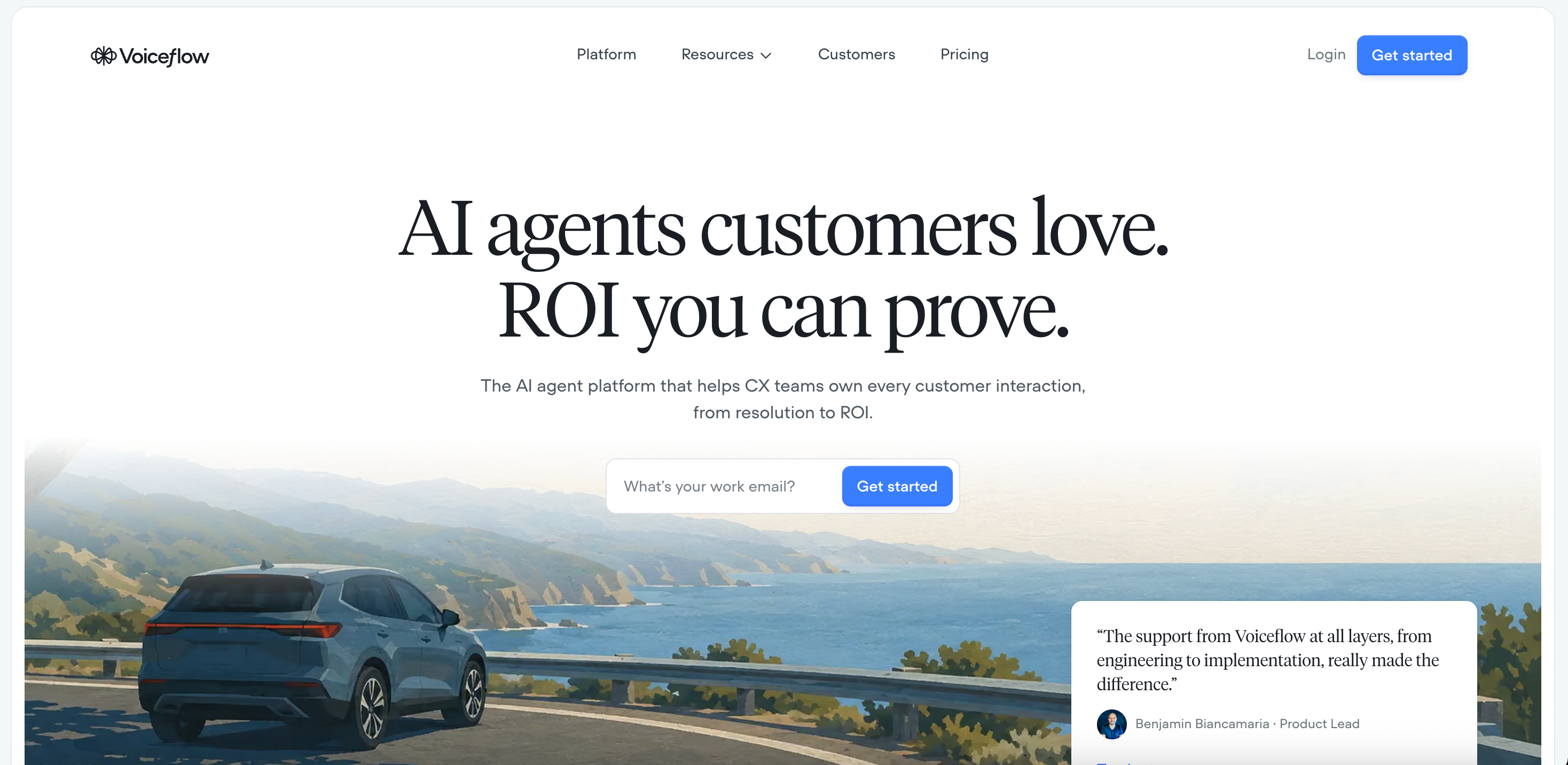
Voiceflow is a design-and-build platform for conversational agents across chat and voice channels. Teams use it to visually design agent behavior, test it, and deploy it to web, phone, and messaging channels. It bills in credits that cover both agent hosting and AI model usage. It is aimed at teams that build agents collaboratively rather than buy a finished product.
Key features:
- Visual agent design with collaborative editing
- Chat and voice agents in one platform
- Knowledge base with retrieval
- Dialogue Manager API for custom deployments
- Testing and prototyping tools before launch
Pros:
- Strong design and prototyping workflow
- Chat and voice in one tool
- AI service costs are passed through at cost, with no markup on model usage
- Static messages, API calls, function calls, and logic steps consume zero credits
Cons:
- Two things draw on credits: agent hosting and AI model tokens
- Voice agents consume credits faster than chat agents because they run in real time
- Extra editor seats are charged separately
- More build effort than a document question answering tool
Pricing: Voiceflow bills in credits covering agent hosting and AI usage. Each credit costs $0.005 on Business monthly plans. A user chat message costs 1 credit. LLM usage is billed on tokens at cost. Agent messages that are not LLM-generated, API calls, function calls, and logic steps cost zero credits. Plan tiers run from a free tier through Pro, Business, and Enterprise. Confirm current tier prices on the Voiceflow pricing page.
Best for: Teams designing conversational agents across chat and voice who want model costs passed through without markup.
How to choose
- Cost per answer is the problem: Choose Nivon. About $0.004 per message on the $12 Starter plan compares with about $0.099 per query on CustomGPT.ai Standard, and no action inflates that rate.
- Want the same documentation grounding at a lower cost: Choose DocsBot. It starts at $49, compared to CustomGPT.ai’s $99, and offers source citations and MCP support. Pick an efficient model to keep credit use down.
- Content is developer documentation: Choose Kapa.ai. It is built for API references, SDK docs, and GitHub issues. You will need to request a quote because it does not publish pricing.
- Need SharePoint sync, HIPAA compliance, or 1,400 file formats today? Stay on CustomGPT.ai. None of the nine alternatives here match that combination, and that is a legitimate reason to keep paying $99 or $499 a month.
- If your questions come in as support tickets rather than via website chat, choose eesel AI at $0.40 per ticket or My AskAI at about $0.10 per ticket. Both run inside your existing helpdesk.
- Need custom conversation logic: Choose Botpress or Voiceflow. Both require engineering time that a document question answering tool does not.
Frequently asked questions
What is the best CustomGPT.ai alternative?
It depends on what is not working. For a lower cost per answer, Nivon charges about $0.004 per message, with a $12 monthly minimum. For the same documentation, DocsBot starts at a lower entry price: $49. For developer documentation specifically, Kapa.ai is purpose-built, though it does not publish pricing.
What is the cheapest CustomGPT.ai alternative?
Nivon has the lowest entry price at $12 per month, with a free plan that includes 150 credits and never expires. Chatbase starts at $40 and DocsBot at $49. Botpress and Voiceflow both have free tiers, but both bill AI usage separately from the plan fee.
How much does CustomGPT.ai cost?
CustomGPT.ai Standard costs $99 per month or $89 on annual billing and includes 10 agents, 1,000 queries per month, 5,000 documents per agent, 60 million words of storage, and 3 team members. Premium costs $499 per month or $449 annually and includes 25 agents, 5,000 queries, 20,000 documents per agent, 300 million words, and 5 team members. Enterprise pricing is custom, and CustomGPT.ai has cited a typical range of $2,000 to $6,000 a month.
Does CustomGPT.ai have a free plan?
No. CustomGPT.ai offers a 7-day free trial with access to Standard plan features. Its own published materials differ on whether a credit card is required to start the trial, so check the signup flow before you begin.
Is there a free alternative to CustomGPT.ai?
Yes. Nivon's free plan includes 150 messages per month, one agent, and one team member, with no card required and no expiry. DocsBot's free plan gives 100 AI credits. Chatbase gives 50 credits but deletes agents after 14 days of inactivity. Botpress and Voiceflow both offer free tiers with separate AI usage charges.
What is a query credit in CustomGPT.ai?
A query credit is the billing unit for a question your agent answers. One customer question consumes at least one credit. Agent actions draw on the same allowance, so a question that triggers a web search consumes more than one credit.
Does web search cost extra in CustomGPT.ai?
Yes, but not as a separate charge. Each web search costs two additional query credits on Premium and three additional query credits on Standard, deducted from your included allowance. Premium allows up to three searches per question, adding a maximum of six credits. The standard allows one search per question.
How many questions does the CustomGPT.ai Standard plan actually answer?
The Standard plan includes 1,000 query credits for $99 per month. If no question triggers a web search, that is 1,000 questions at about $0.10 each. If each question triggers one web search, each question consumes 4 credits, totaling about $0.40 for 250 questions.
Does CustomGPT.ai get cheaper per query as you scale?
No. Standard costs $99 for 1,000 queries, which is $0.099 per query. The Premium plan costs $499 for 5,000 queries, which is $0.0998 per query. The rate is effectively the same on both plans, so a higher tier buys volume rather than a discount.
Which CustomGPT.ai alternatives provide source citations?
Nivon, DocsBot, Kapa.ai, Chatbase, SiteGPT, eesel AI, and My AskAI all ground answers in your connected sources. DocsBot and Kapa.ai attach citations to answers as a core feature, which matters most for documentation and compliance use cases.
Which one to pick
CustomGPT.ai is a strong retrieval platform. The grounding is solid, the citations are real, and the compliance coverage is genuine. If SharePoint sync, HIPAA, or 1,400 file formats are requirements, it’s worth the price.
The issue is the meter. A query credit is not a customer question; the per-query rate does not improve as you scale, and the only step up from $99 is $499.
If you want the cost of an answer to stay fixed, Nivon charges 1 credit per message across its models, starting at $12 a month, with a free plan that never expires.