9 Best Chatbase Alternatives in 2026
The best Chatbase alternatives in 2026 are compared on pricing, live chat, human handoff, and which AI chatbot platforms publish their model credit costs.

Vinish Bhaskar
Sep 14, 2026
Chatbase is a no-code AI chatbot builder. You train an AI agent on your documents, links, and text, then embed it on your site. It connects to more tools than almost any other chatbot platform in its category. Voice, telephony, and outbound campaigns are available from the Standard paid plan. Chatbase reports more than 10,000 business customers.
Chatbase bills in message credits. Hobby costs $40 per month for 700 credits; Standard costs $150 for 4,000 credits; and Pro costs $500 for 15,000 credits.
One thing separates Chatbase from most AI chatbot platforms here. It does not publish how many credits each AI model consumes. Chatbase distinguishes limited models from advanced models by tier, but gives no per-model figure, so you cannot calculate how many AI conversations a plan buys before you subscribe.
If you are looking for a Chatbase alternative, this page compares nine of them on pricing, cost per credit, top-up rates, human handoff, and how clearly each vendor explains its meter.
Quick picks
- Lowest cost per message: Nivon, at about $0.004 on the $12 Starter plan.
- Most transparent pricing: Chatling, which publishes the credit cost of every AI model it supports.
- Cheapest top-up: Chatwith at $9 per 1,000 messages, against Chatbase's $40.
- Best free plan: Nivon. 150 messages a month, no card, no expiry, and no agent deletion.
- Best for documentation: DocsBot or CustomGPT.ai, both with source citations.
- Best for helpdesk ticket automation: eesel AI at $0.40 per ticket, with no base fee.
Why teams look for Chatbase alternatives
Chatbase earns its position. Its integration list is the widest in this category. Voice, telephony, and outbound campaigns are built in rather than bolted on, and no other AI chatbot platform on this page offers them. It supports AI models from OpenAI, Anthropic, Google, DeepSeek, Meta, Mistral, MoonshotAI, and Z.ai. Enterprise adds SSO, audit logs, HIPAA eligibility, and zero data retention.
Here is what prompts support teams to look for an alternative to Chatbase.
Do not publish credit costs
Chatbase's pricing page separates limited models from advanced models by plan tier. It does not state how many credits a reply costs on any given model.
That matters because the allowance is the product. A 700-credit Hobby plan means 700 AI conversations if each reply costs one credit, and far fewer if premium models cost more. Without published figures, you cannot work out your capacity until you are already paying.
Chatling publishes a full table covering all 29 of its AI models, from 0.5 credits up to 25. DocsBot publishes multipliers, listing GPT-5.6 Sol at 20x. Chatbase publishes neither.
Top-up credits
When you run out, Chatbase's auto-recharge add-on costs $40 per 1,000 credits. That is $0.04 per credit and the highest top-up rate on this page.
| Tool | Top-up cost per 1,000 |
|---|---|
| Chatwith | $9 |
| DocsBot | About $9.80 |
| Chatling | $10 |
| Botsonic | $12.50 |
| SiteSpeakAI | $25 |
| Chatbase | $40 |
Branding removal costs
Removing "Powered By Chatbase" costs $99 a month. On the $40 Hobby plan, the branding add-on costs nearly two and a half times as much as the paid plan itself. Chatling charges $35 for the same thing, and Botsonic $49.
Extra AI agents cost
Adding agents to your workspace costs $25 per AI agent per month. Running separate bots for customer support, sales, and internal help adds $50 per month to your plan. Chatling charges $3 per extra agent and Chatwith $9.
Free plan Limit
The free tier includes 50 message credits and one member. Chatbase's pricing page states that agents on the free plan are deleted after 14 days of inactivity. It works as a sandbox for evaluating the chatbot builder rather than a free plan you can leave running.
Live chat, helpdesk, and API cost
Helpdesk features, voice, telephony, outbound campaigns, API access, personalization, auto-retrain, and advanced integrations, including Stripe and Zendesk, all begin at Standard, which costs $150 per month. The $40 Hobby plan covers only basic integrations and analytics.
How to compare these tools
Ask every AI chatbot platform the same questions.
- Does the vendor publish how many credits each AI model consumes?
- What is the cost per credit on the entry paid plan?
- What do top-up credits cost when you run out?
- How many AI agents does the plan include, and what do extras cost?
- Is human handoff to a live agent included, or gated to a higher tier?
- Which plan unlocks API access, live chat, and helpdesk integrations?
- Does the free plan expire, or does it delete your trained bot?
Chatbase alternatives compared
| Tool | Billable unit | Entry price (monthly) | Cost per unit at entry | Publishes AI model costs | Human handoff | Free plan |
|---|---|---|---|---|---|---|
| Nivon | One credit per message | $12 | About $0.004 | Not needed, flat rate | Yes, with full thread | Yes, 150 credits, never expires |
| Chatwith | Messages | $19 | $0.019 | Not applicable, flat rate | Yes | Yes, 25 messages |
| Botsonic | Bot messages | $19 | $0.019 | No, gated by tier | No, $199 add-on | No, 7-day free trial |
| Chatling | AI credits | $25 | $0.014 per credit | Yes, all 29 models | Yes, with AI summary | Yes, 200 credits |
| DocsBot | AI credits | $49 | About $0.010 per credit | Yes, multipliers listed | Not published | Yes, 100 credits |
| SiteGPT | Messages | $59 | About $0.015 | Yes, 10x split stated | Yes | No, 7-day free trial |
| CustomGPT.ai | Query credits | $99 | About $0.099 | Web search costs published | Yes | No, 7-day free trial |
| eesel AI | Per ticket or chat session | No base fee | $0.40 | Flat per task | Yes, native to helpdesk | $50 free usage |
| Fini | Per resolution after allowance | $3,600 | $0.25 at allowance | Flat per resolution | Yes, escalations free | No |
| Chatbase | Message credits | $40 | About $0.057 per credit | No | Yes | Yes, 50 credits, deleted after 14 days idle |
The 9 best Chatbase alternatives
Nivon AI
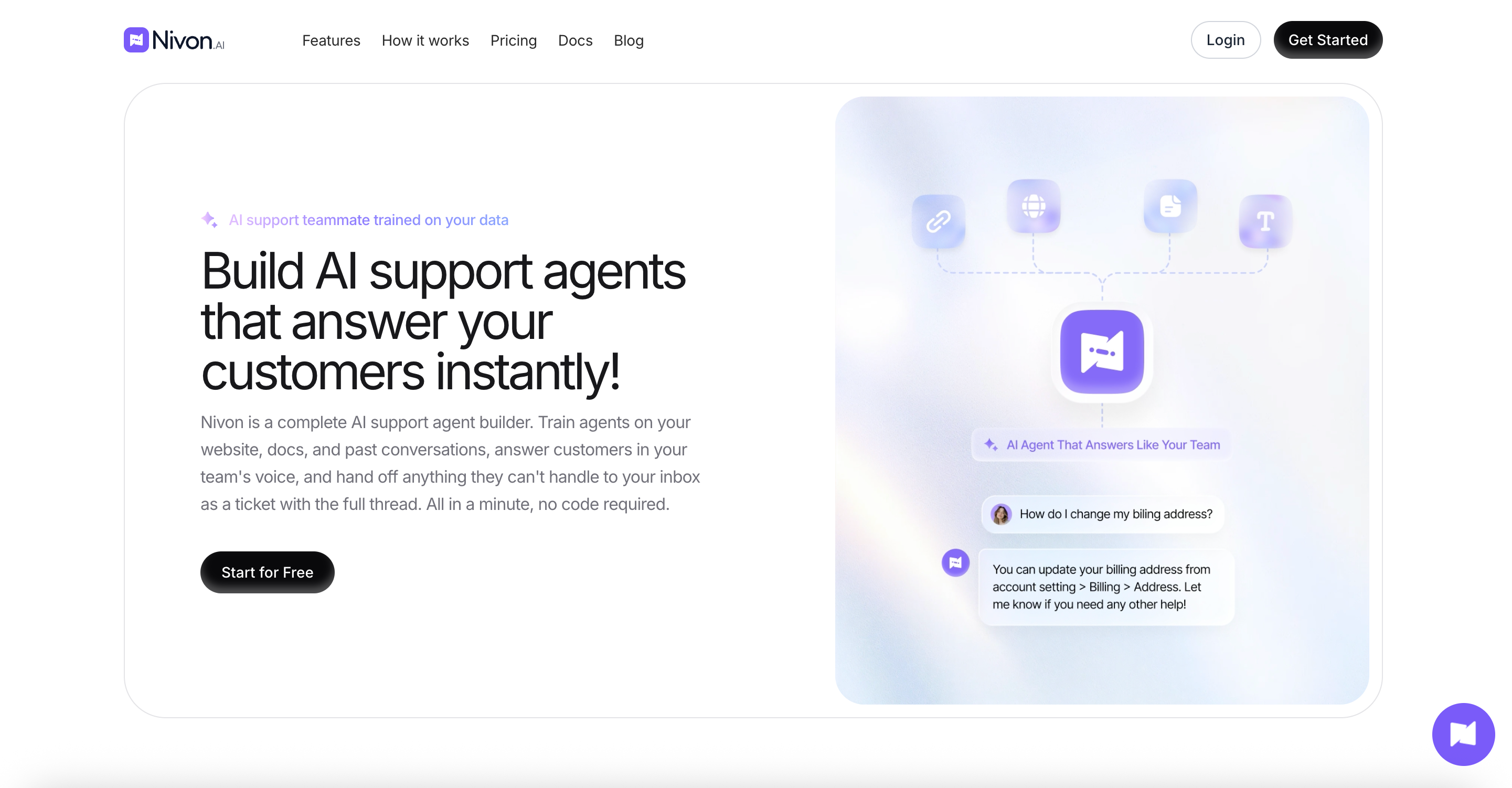
Nivon is a no-code AI chatbot builder for customer support. You train an AI agent on your website, documents, FAQs, and past support tickets, and it answers from that knowledge base. When it cannot answer, it hands the conversation to a human agent, including the full thread. Unlike Chatbase, one credit equals one message on any AI model, so capacity does not change with your model choice. Nivon AI, built by Pimjo, ran it on its own products for 45 days before release.
Key features:
- Trains on website crawls, sitemaps, uploaded documents, Google Drive, OneDrive, FAQs, pasted text, and past support tickets
- 20+ AI models across OpenAI, Anthropic, Google, and xAI, switchable per agent
- Guardrails that define what the agent handles, refuses, never shares, and escalates
- Human handoff carries the full conversation, so customers never repeat themselves
- Separate workspaces with admin and member roles
- Replies in 95+ languages, with analytics on volume, resolution rate, and response time
Pros:
- About $0.004 per message against Chatbase Hobby's $0.057
- No model multiplier, so the allowance means the same thing whichever AI model you run
- Free plan gives 150 messages, does not expire, and does not delete your bot
- Business plan allows unlimited AI agents rather than $25 each
- Seats are included up to each plan's limit, with no per-seat pricing
Cons:
- No voice, telephony, or outbound campaigns, which Chatbase offers from Standard
- Far fewer integrations. Google Drive and OneDrive are live, Slack and Telegram are in progress
- No WhatsApp, Instagram, or Messenger channels
- SOC 2 Type II is in progress, not complete
Pricing: Free at $0 with 150 credits a month and 1 team member. Starter is $12 a month, or $9 on annual billing, with 3,000 credits and 3 members. Growth is $39 a month, or $29 annually, with 12,000 credits and 5 members. Business is $79 a month, or $59 annually, with 30,000 credits, unlimited agents, and 15 members.
Best for: Support teams that want to know how many AI conversations their plan buys. If your use case needs voice, telephony, or a long list of CRM integrations, Chatbase does more.
Chatwith
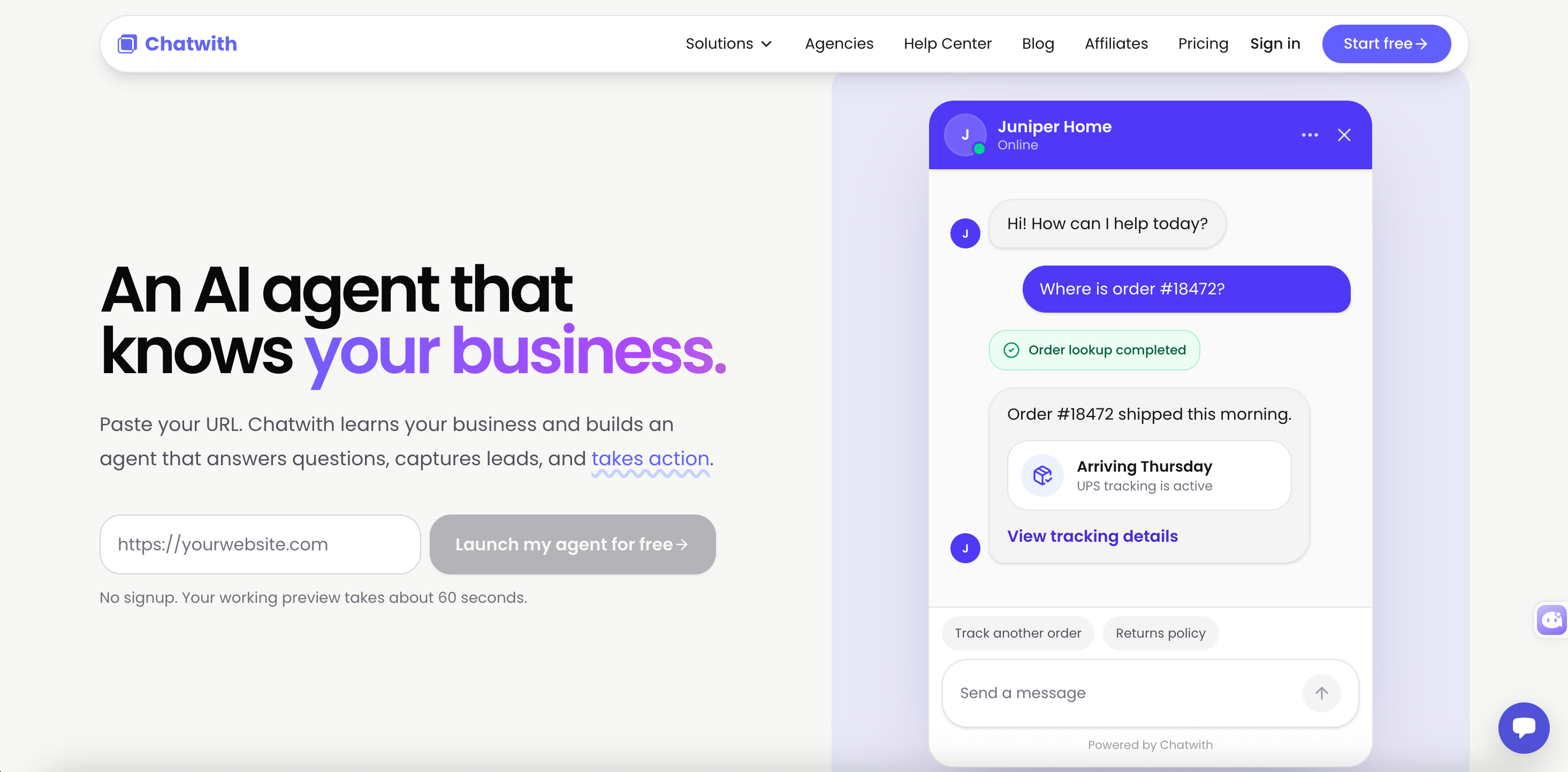
Chatwith is an AI chatbot builder trained on your files, website, sitemap, text, and YouTube videos. Its strength is AI actions. The agent calls APIs, checks Shopify and WooCommerce order status, and triggers webhooks. Like Chatbase, it is no-code, but it treats each message as a single message with no model weighting.
Key features:
- Connects to APIs and external services for real AI actions
- MCP action calls are metered separately from messages
- Shopify and WooCommerce order status and product search
- Model switching, with your own LLM API key supported
- Human escalation, guardrails, and lead collection
- WordPress, WhatsApp, Slack, Telegram, and email channels
Pros:
- Top-up messages cost $9 per 1,000 against Chatbase's $40
- One message costs one message, with no AI model weighting
- Unlimited training sources on every plan, including the free tier
- Extra AI agents cost $9 each against Chatbase's $25
Cons:
- The free plan allows 25 messages a month, half of Chatbase
- MCP action calls are a second meter at $6 per 1,000
- Hobby costs about twice as much per message as the Standard tier above it
- No voice or telephony
Pricing: Free at $0 with 25 messages a month, 1 agent, and 500,000 training characters. Hobby is $19/month with 1,000 messages. The standard plan is $99 with 10,000 messages and 3 agents. Business is $399 with 40,000 messages and 5 agents. Add-ons cost $9 per 1,000 extra messages, $9 per extra agent, and $6 per 1,000 MCP action calls.
Best for: Teams whose use case needs the AI agent to call APIs and complete transactions, at half of Chatbase's entry pricing.
Botsonic
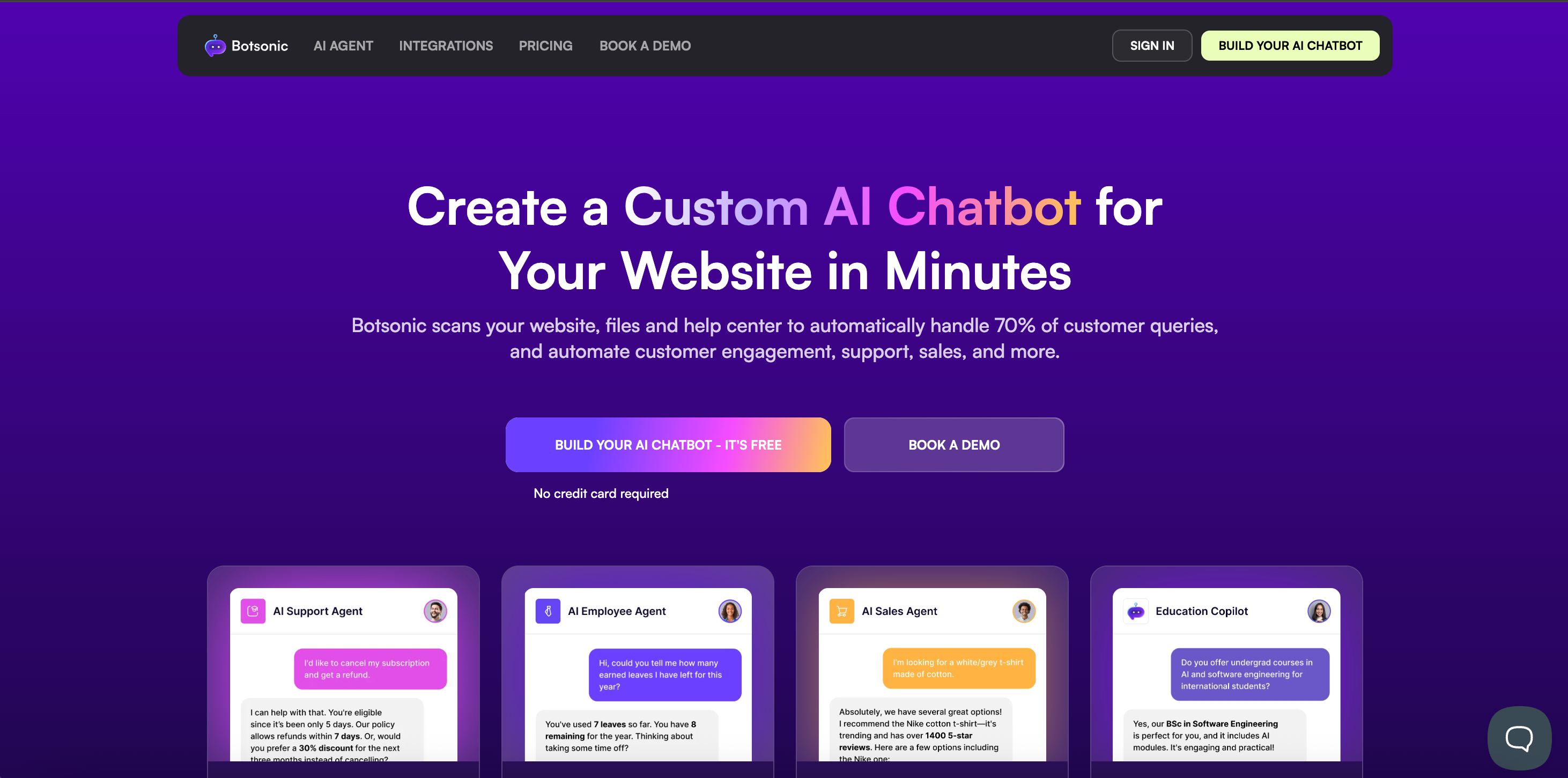
Botsonic is Writesonic's AI chatbot platform. You train a bot on your website and documents, then deploy it to your site, plus WhatsApp, Facebook Messenger, Telegram, Slack, and WordPress. Its Agentic Actions and workflow builder let the bot complete tasks rather than only answer questions.
Key features:
- WhatsApp, Messenger, and Telegram from the entry paid plan
- Agentic Actions, rising from 3 to 10 by tier
- Industry-specific workflows on the Advanced plan
- Auto-sync from your website and third-party platforms on the Advanced
- Lead capture forms and sitemap upload
- SOC 2 and GDPR compliance
Pros:
- $19 entry pricing against Chatbase's $40
- WhatsApp, Messenger, and Telegram from the entry tier
- Annual billing gives two months free
- 30% discount for education and non-profit organizations
Cons:
- Human handoff to Zendesk or Freshdesk costs $199 a month as an add-on
- The per-message rate rises with tier. Advanced is $0.025 per message against Professional's $0.016
- Branding removal costs $49 a month, and API access another $49
- No free plan, only a 7-day free trial
- Starter runs GPT-4o mini only
Pricing: Starter is $19/month or $16/year, with 1,000 messages and 1 chatbot. Professional is $49 monthly, or $41 annually, with 3,000 messages and 2 chatbots. Advanced is $299 monthly, or $249 annually, with 12,000 messages. Enterprise is custom. Extra messages cost $25 per 2,000.
Best for: Teams that need WhatsApp, Messenger, and Telegram at the lowest entry price and do not need human handoff.
Chatling
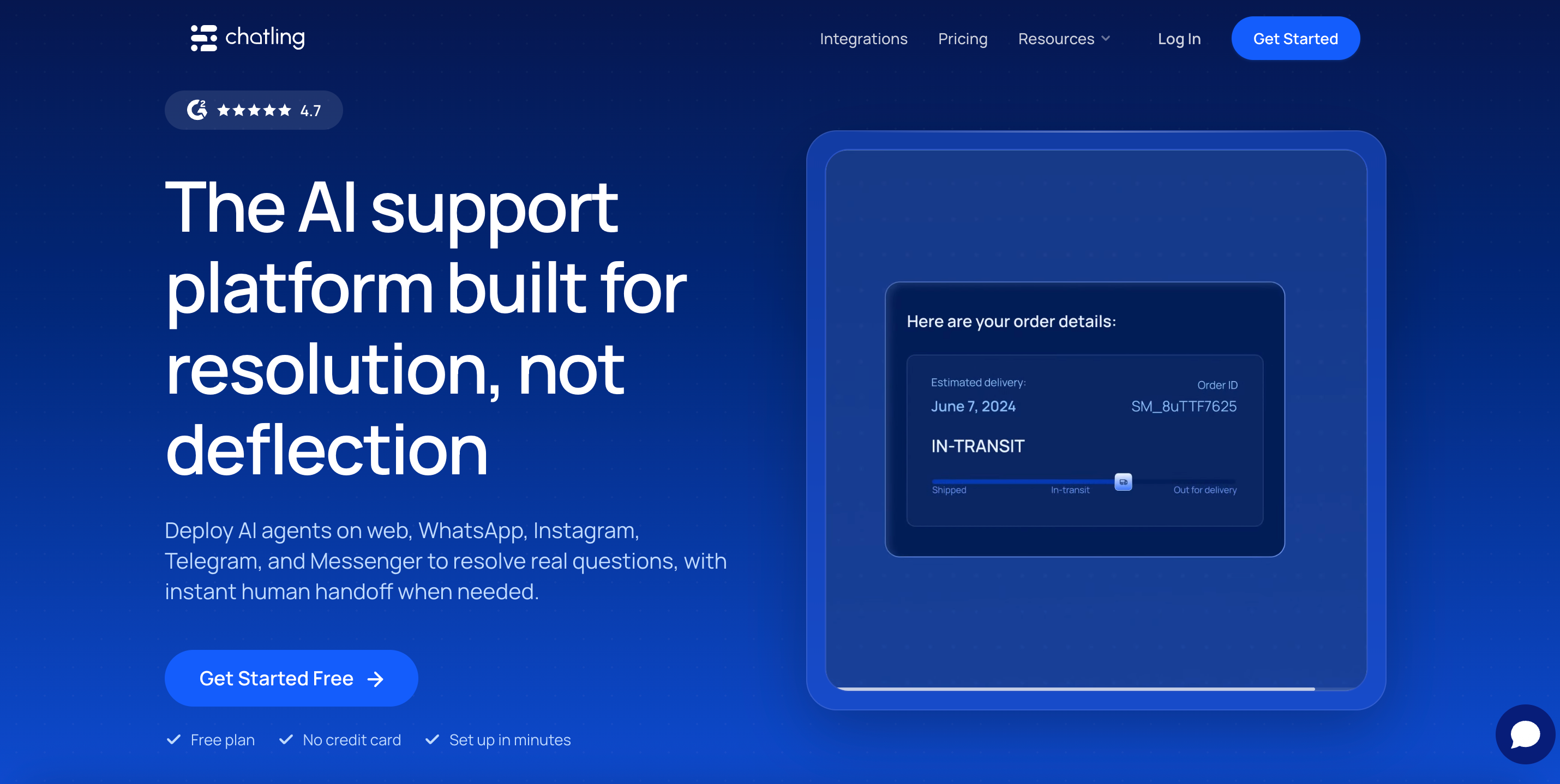
Chatling is a no-code AI chatbot builder with a visual workflow builder. You design conversation branches by dragging blocks, or let the AI answer from your knowledge base. It supports 29 AI models and publishes the exact cost of credit for each one, which is the clearest pricing disclosure in this category.
Key features:
- Visual drag-and-drop workflow builder
- 29 AI models across OpenAI, Anthropic, Google, Mistral, xAI, and DeepSeek
- Live chat with human handoff and AI-generated chat summaries for the agent picking up
- AI actions that let the agent complete tasks during a conversation
- WhatsApp, Instagram, Messenger, and Telegram on paid plans
- Round robin routing on higher tiers
Pros:
- It publishes the credit cost of all 29 AI models, so you can calculate capacity before buying
- Unlimited non-AI chats on every plan, including the free tier
- Free plan gives 200 AI credits against Chatbase's 50, and does not delete your bot
- Branding removal costs $35 against Chatbase's $99
- Extra AI agents cost $3 each against Chatbase's $25
Cons:
- Credits do scale by AI model, from 0.5 per reply up to 25 on Claude Opus 5
- The $25 Starter plan buys 1,750 credits, which is 70 AI conversations on the most expensive model
- Extra seats cost $10 each per month
- No voice or telephony
Pricing: Free at $0 with 200 AI credits. Starter is $25 a month, or $21 annually at $250 a year, with 1,750 credits. Growth is $75 a month, or $63 annually at $750, with 6,000 credits. Scale is $295 per month, or $ 2,950 annually, with 35,000 credits and branding removal included.
Best for: Teams that want to see the credit maths before committing. Chatling has the same model-weighted pricing as most of this category, but it tells you the numbers.
DocsBot
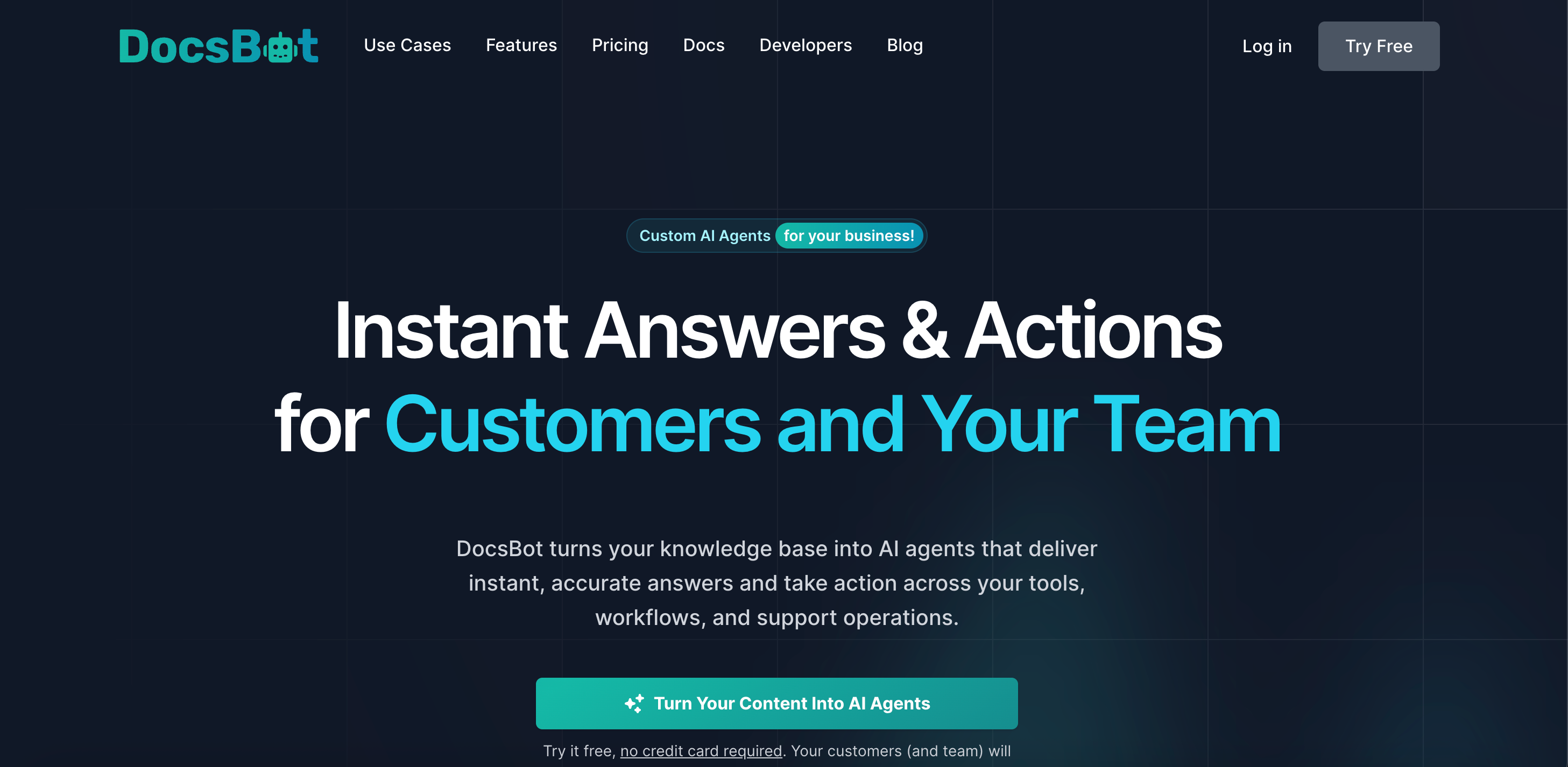
DocsBot is an AI chatbot builder trained on documentation, with source citations attached to answers. It focuses on retrieval accuracy for technical and product content rather than general website chat. It supports remote MCP connections, which few AI chatbot platforms offer.
Key features:
- Source citations are attached to every answer
- Remote MCP connections
- Advanced document parsing for complex file layouts
- Lead collection forms and scheduling tools, including Calendly and Cal.com
- Knowledge base refresh on a monthly or weekly schedule by plan
- Slack, Messenger, WhatsApp, Telegram, and Zapier integrations
Pros:
- Publishes AI model multipliers, listing GPT-5.6 Sol at 20x and GPT-5.6 Terra at 8x
- Source citations by default
- Free plan gives 100 AI credits
- 14-day money-back guarantee
Cons:
- Advanced document parsing costs 2 AI credits per page, drawing on the same allowance
- The entry paid plan includes one bot and one team user
- Higher entry pricing than Chatbase at $49
- Free plan bots are deleted after 30 days of inactivity
Pricing: Free at $0 with 100 AI credits, 1 bot, 50 source pages, and 1 team user. Paid tiers add 5,000, 15,000, and 60,000 AI credits with 1, 5, and 10 team users. The AI credit add-on costs $49 per month per 5,000-credit increase. Confirm current plan pricing on the pricing page.
Best for: Teams whose knowledge base is technical documentation and who need every answer to cite its source.
SiteGPT
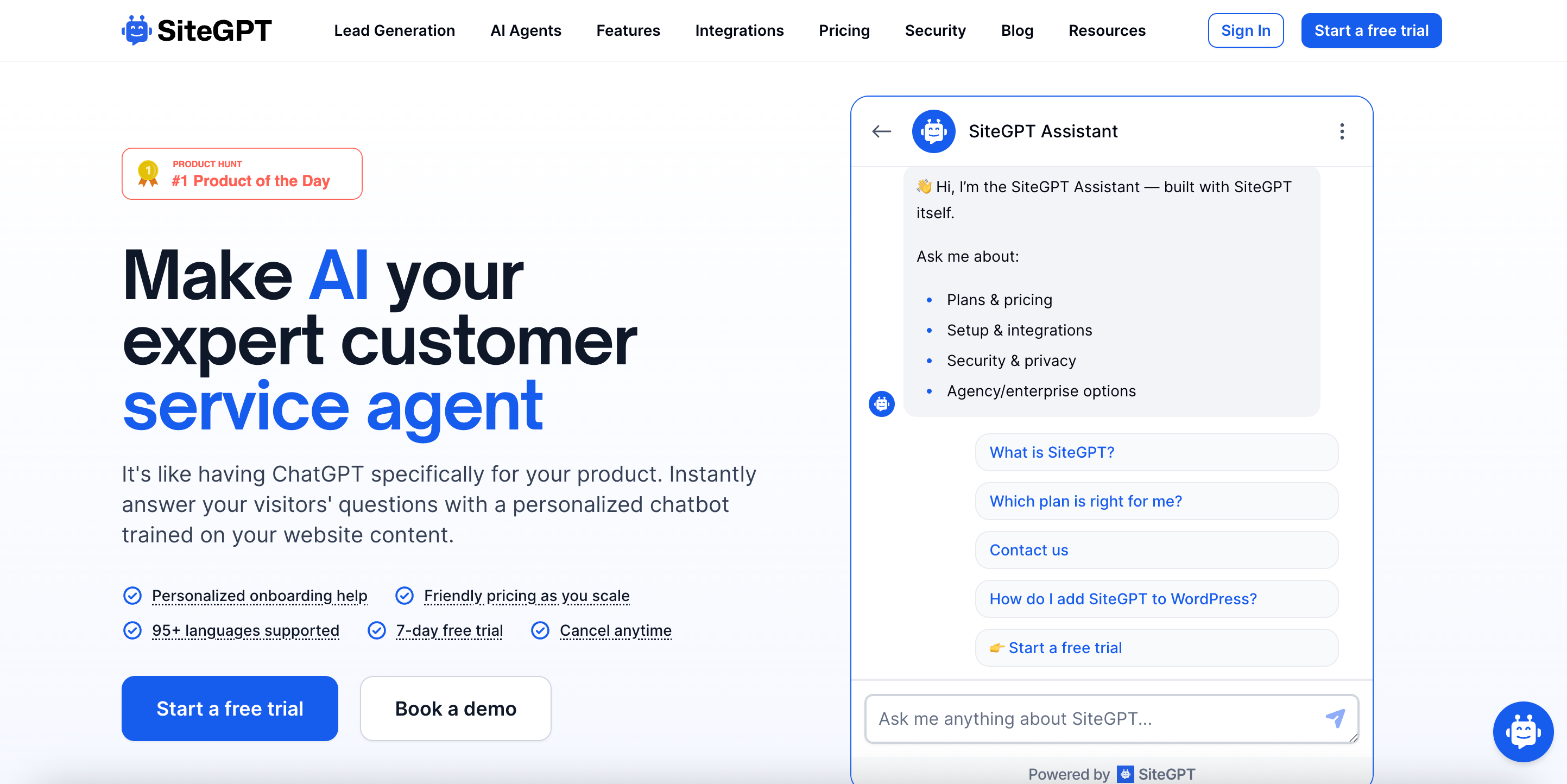
SiteGPT trains an AI chatbot on your website by crawling your pages. You enter a URL, select the pages to train on, and embed the result. It pulls content from websites, sitemaps, files, YouTube, GitHub, Notion, Google Drive, and Dropbox. Its unit is one message, defined as a question plus its reply counted together.
Key features:
- Trains from 12 content source types, including GitHub and YouTube
- Lead capture is built into the chat flow
- Slack, Zapier, Webflow, Shopify, and WordPress integrations on Growth and above
- Zendesk AI Agent on the Scale plan
- API access from the Growth plan
- Human handoff to a live agent
Pros:
- One message covers a question and its reply together
- It states the AI model split openly, giving 4,000 messages on the mini model or 400 on GPT-4.1
- Annual billing saves up to 40%, the largest discount here
- Wide range of knowledge base sources
Cons:
- No free plan, only a 7-day free trial
- The model split moves the allowance tenfold
- The Starter plan has no integrations and no API access
- The price shown first is the annual rate. Monthly is $59, $129, and $429
Pricing: Starter is $59 a month, or $39 annually, with up to 4,000 messages, 1 chatbot, 1,000 pages, and 1 team member. Growth is $129 per month or $79 per year, with 10,000 messages, 2 chatbots, and 4 team members. Scale is $429 per month or $259 per year, with 40,000 messages, 3 chatbots, and 10 team members. Extra message packs cost $59 per 5,000 monthly or $39 per 5,000 annually.
Best for: Teams training an AI agent on content spread across GitHub, Notion, and Drive, who will run an efficient model.
CustomGPT.ai
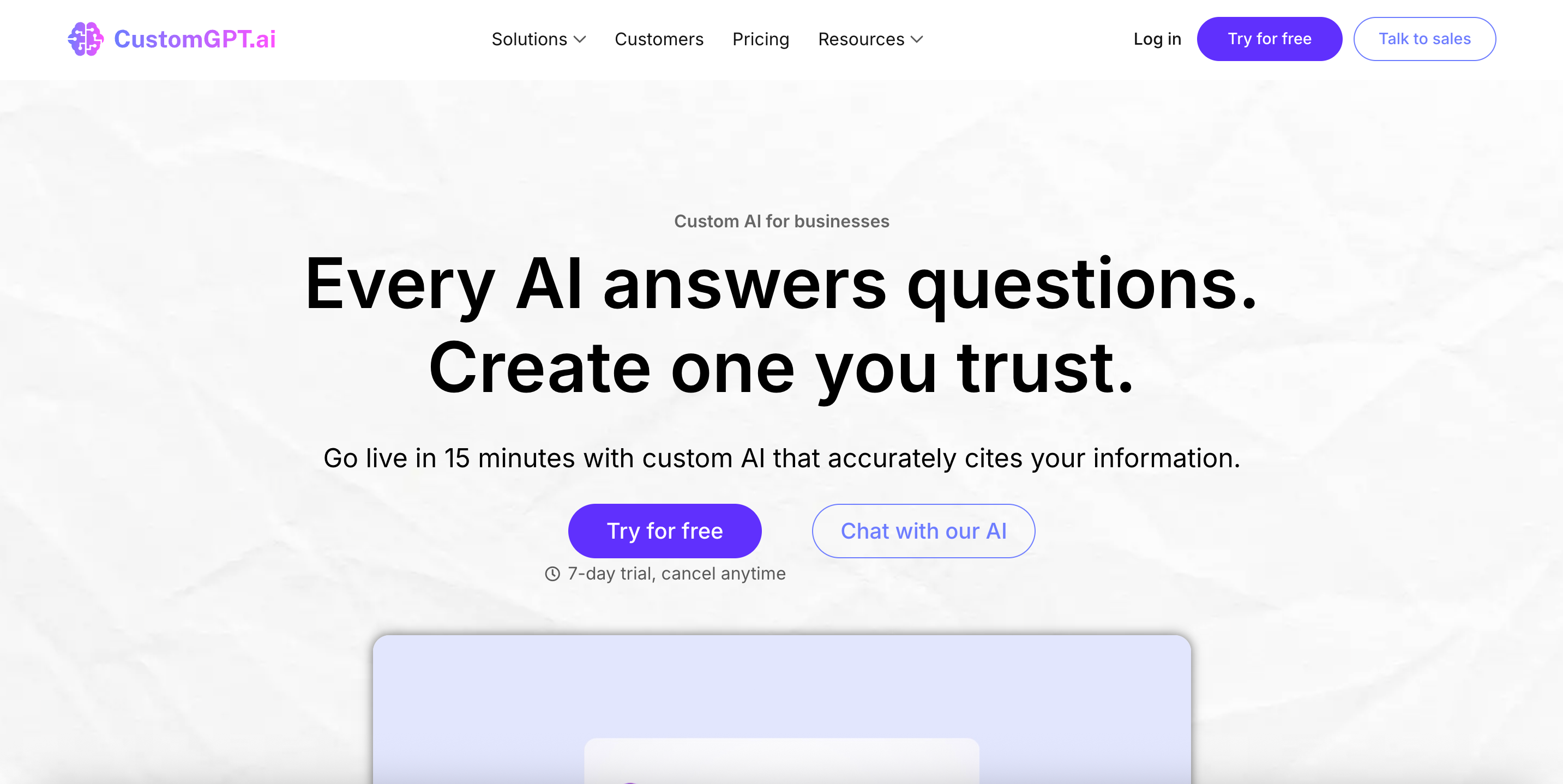
CustomGPT.ai is a retrieval-augmented generation platform for custom AI agents. It grounds answers in your own documents, attaches source citations, and supports over 1,400 file formats. It integrates with SharePoint, Google Drive, Zendesk, HubSpot, and Salesforce and holds SOC 2 Type II, GDPR, and HIPAA compliance certifications.
Key features:
- Grounded answers with source citations
- Support for over 1,400 document formats
- SharePoint connector with auto-sync on Premium
- RAG API access
- Anti-hallucination controls
- SOC 2 Type II, GDPR, and HIPAA compliance
Pros:
- The broadest document format support on this page
- Compliance coverage is complete rather than in progress
- Publishes exactly what web search costs in extra query credits
- Citations on answers by default
Cons:
- $99 entry pricing and a five-fold jump to $499 for the next tier
- The per-query rate does not improve with volume, staying near $0.10 on both plans
- Web search consumes extra credits: three additional on Standard, two per search on Premium
- White-labeling requires the Premium plan
Pricing: Standard is $99 per month or $89 annually, with 10 agents, 1,000 queries per month, 5,000 documents per agent, and 3 team members. Premium is $499 a month, or $449 annually, with 25 agents, 5,000 queries, 20,000 documents per agent, and 5 team members. Enterprise is custom, and CustomGPT.ai has cited a typical range of $2,000 to $6,000 a month.
Best for: Regulated teams whose use case needs HIPAA, SharePoint sync, and citations on every answer.
eesel AI
eesel AI is an AI support agent that plugs into the helpdesk you already run. It trains on past tickets, help center articles, and documents in Confluence, Notion, and Google Drive, then drafts and resolves tickets inside Zendesk, Freshdesk, and Intercom. Unlike Chatbase, it is not a website widget, so it works inside the ticket queue rather than in front of it.
Key features:
- Runs inside Zendesk, Freshdesk, Intercom, Slack, and Shopify
- Trains on past tickets alongside your knowledge base
- Simulation mode to test against historical tickets before going live
- Separate helpdesk, blog writer, and e-commerce agents under one account
- Spending cap with alerts at 50%, 75%, and 100% of your limit
- Gradual rollout, routing only part of your queue to the AI
Pros:
- No monthly base fee, so you pay only for what the agent handles
- One ticket or chat session is one task, no matter how many messages it contains
- $50 in free usage with no credit card
- Human handoff is native, since the agent already works in your helpdesk
- SOC 2 Type II, GDPR, and CCPA
Cons:
- $0.40 per ticket is expensive at high volume compared with credit-based paid plans
- Tasks are billed regardless of outcome, so failed attempts still cost $0.40
- Blog post drafts cost $4.00 each
- The Enterprise tier adds a $1,000 a month platform fee on top of usage
Pricing: $0.40 per support ticket or chat session. Light tasks, such as dashboard lookups, are free. Heavy tasks such as blog post drafts cost $4.00. There is no platform fee, per-seat fee, or monthly minimum. Enterprise costs $1,000 a month plus usage. Annual commitment saves up to 25%.
Best for: Support teams that want AI customer service inside an existing helpdesk rather than a chatbot on a website.
Fini
Fini is an autonomous AI agent platform covering voice, chat, and email customer support. It resolves customer issues end-to-end and charges only when it fully resolves one. Escalations to a human agent are free. Each plan bundles the platform, implementation, and a monthly allowance of resolutions into a single price. It sits far above Chatbase in both AI capabilities and cost.
Key features:
- Handles voice, chat, and email in one AI agent
- Implementation is included in the plan price
- Per-resolution rate falls as your volume tier rises
- Shared customer success and priority email support
- Reopened conversations within 72 hours are not billed twice
Pros:
- No per-seat pricing
- Escalations, greetings, spam, and abandoned sessions are never billable
- You pay only when the agent fully resolves an issue
- The overage rate drops from $0.89 to $0.49 as you move up tiers
Cons:
- The entry plan costs $3,600 a month, ninety times Chatbase's Hobby plan
- You pay the full plan price even in a quiet month
- There is no free plan and no self-serve free trial
- Far more platform than most Chatbase users need
Pricing: Growth is $3,600 per month for 2,000 resolutions, and $0.89 per resolution after that. Scale is $9,000 a month with 8,000 resolutions and $0.69 overage. Enterprise is $18,000 a month with 30,000 resolutions and $0.49 overage. Annual billing includes two months free, making the yearly prices $36,000, $90,000, and $180,000.
Best for: Support organizations running at least 2,000 resolutions a month across voice, chat, and email. If you are comparing against a $40 Chatbase plan, this is not your tier, and it is on this list only as the endpoint if you outgrow the category entirely.
How to choose
- Calculate capacity before you buy: Choose Chatling. It publishes the cost of credit for every AI model it supports. Chatbase does not.
- Cost per message is the problem: choose Nivon. About $0.004 per message compares with about $0.057 on Chatbase Hobby, and no AI model changes that rate.
- If you keep buying top-ups, choose Chatwith at $9 per 1,000 or Chatling at $10. Chatbase charges $40.
- If you run several bots, choose Chatling at $3 per additional AI agent or Chatwith at $9 per additional AI agent. Chatbase charges $25 each, and Nivon's Business plan allows unlimited agents.
- Need voice, telephony, or outbound campaigns: Stay on Chatbase. No other AI chatbot platform on this page offers them, and Nivon has none of the three. That is a genuine reason to keep paying $150 a month for Standard.
- Specific CRM or helpdesk integration: Stay on Chatbase. Its list, which covers Stripe, Zendesk, Salesforce, Intercom, HubSpot, Zoho Desk, Freshdesk, Help Scout, Gorgias, and Odoo, does not match here.
- If your questions arrive as support tickets, choose eesel AI, which automates customer support inside your existing helpdesk.
- If answers must cite sources, choose DocsBot or CustomGPT.ai.
Frequently asked questions
What is the best Chatbase alternative?
It depends on what is not working. For a lower cost per message, Nivon charges about $0.004 on a $ 12-a-month plan. For published AI model credit costs, Chatling lists all 29 of its models. For cheaper top-ups, Chatwith charges $9 per 1,000, compared to Chatbase's $40. For AI customer support inside an existing helpdesk, eesel AI charges $0.40 per ticket.
What is the cheapest Chatbase alternative?
Nivon has the lowest entry pricing at $12 a month and the lowest cost per message at about $0.004. Chatwith and Botsonic both start at $19, and Chatling at $25. eesel AI has no base fee, charging $0.40 per ticket handled.
How much does Chatbase cost?
Chatbase is free at $0 with 50 message credits and 1 member. Hobby costs $40 a month with 700 credits and 2 members. Standard costs $150 with 4,000 credits and 3 members. Pro costs $500 with 15,000 credits and 5 members. Enterprise is custom. Yearly billing takes 20% off.
Does Chatbase have a free plan?
Yes, with 50 message credits per month, 1 member, and limited access to the AI model. Chatbase's pricing page states that free-plan agents are deleted after 14 days of inactivity, so the free tier serves as an evaluation sandbox rather than a plan you can leave running.
Is there a free alternative to Chatbase?
Yes. Nivon's free plan gives 150 messages a month, three times Chatbase's 50, with no card, no expiry, and no deletion. Chatling gives 200 AI credits plus unlimited non-AI chats. DocsBot gives 100 AI credits. Chatwith gives 25 messages.
How many credits does one Chatbase message use?
Chatbase does not publish this. Its pricing page separates limited models from advanced models by plan tier, but gives no per-model credit figure. Chatling and DocsBot both publish their per-model costs, so you can calculate capacity before subscribing.
What do extra Chatbase credits cost?
Auto-recharge credits cost $40 per 1,000, which is $0.04 each. This is the highest top-up rate among the AI chatbot platforms on this page. Chatwith charges $9 per 1,000, DocsBot about $9.80, Chatling $10, Botsonic $12.50, and SiteSpeakAI $25.
What add-ons does Chatbase charge for?
Chatbase lists three add-ons on its pricing page: auto-recharge credits at $40 per 1,000, extra AI agents at $25 per agent per month, and removal of "Powered By Chatbase" branding at $99 a month.
Which Chatbase plan includes live chat and API access?
API access begins on the Standard plan at $150 per month, alongside helpdesk features, voice, telephony, outbound campaigns, personalization, auto-retrain, and advanced integrations, including Stripe and Zendesk. The $40 Hobby paid plan includes only basic integrations and analytics.
Do these Chatbase alternatives support human handoff?
Yes, Nivon passes the full conversation thread to a human agent. Chatling includes live chat with an AI-generated summary for whoever picks up. Chatwith, SiteGPT, and CustomGPT.ai all support escalation. eesel AI and Fini handle it natively because they work inside a helpdesk.
Which one to pick
Chatbase's integration list and its voice and telephony features are real advantages. If your use case needs an AI agent that answers on the phone and updates Salesforce, nothing else on this page does both.
The difficulty is working out what you are buying. Without published per-model credit costs, a 700-credit plan could mean 700 AI conversations or a fraction of that. The $40 per 1,000 top-up rate and the $99 branding fee further widen the gap between the plan price and the real cost.
If you want the allowance to mean one thing, Nivon charges one credit per message on any AI model, starting at $12 a month with a free plan that does not expire.